




Nebihood: A Privilege or a Heavy Burden? To properly understand the office of prophethood, one must first look at the historical reality of this role. Prophets faced immense physical and psychological pressures while conveying God's true religion. The Quran makes this reality plain in numerous verses. In Surah Ash-Shu'ara 26:153, the accusation directed at the prophet by the polytheists is relayed as follows: "You are only one of those bewitched." Such psychological attacks reveal that prophets did not merely assume a spiritual duty — they were also compelled to withstand harsh accusations, insults, and slander campaigns from all segments of society. Physical threats were equally inseparable from this picture. In Surah Al-Imran 3:21, the following statement appears regarding the killing of prophets: "Indeed, those who disbelieve in the signs of Allah and kill the prophets without right and kill those who order justice from among the people — give them tidings of a painful punishment." This verse stands as clear testimony that massacres targeting prophets took place throughout history. Among concrete examples, perhaps the most striking is the casting of the Prophet Ibrahim into fire, recounted in Surah Al-Ankabut 29:24. The fact that a prophet was subjected to being thrown into fire for conveying his message lays bare, in full starkness, the immense cost that prophethood demands. Women Being Exempt from Prophethood: A Deficiency or a Mercy? The traditional answer given to this question holds that the matter is not merely one of distributing responsibilities, but rather a divine protection mechanism. When social pressure and resistance are considered, it becomes evident that the attacks prophets faced were not solely physical. Throughout history, polytheistic communities resorted to every weapon available against messages that threatened their traditional religious understanding. Among the most commonly employed of these weapons were moral accusations built around chastity. The slander directed against Aisha, the wife of the Prophet Muhammad, demonstrates how effectively such attacks could be wielded as a social weapon. A female prophet could have become the most vulnerable target of such a slander mechanism. Viewed within this framework, the exemption of women from the office of prophethood can be read not as a degradation or exclusion, but as a concrete reflection of sensitivity toward women's nature and safety. By exempting women from this role, God protected them from the harshest physical and psychological attacks directed at prophets throughout history. Reflections in Modern Times This issue extends far beyond an abstract historical debate and reaches directly into the present day. Pressures directed at those who raise their voices in the religious sphere persist in the modern age as well. The reactions targeting individuals who question the hadith tradition or advocate a Quran-centered approach illustrate this concretely. Some have been demeaned by being depicted as dancers, some have been called mad, and others have received death threats — all for defending the true religion. The existence of individuals who pay this price despite not being prophets reveals the extent to which the historical difficulty of prophethood still resonates today. It also prompts reflection that, had these individuals been women, the pressures they faced would in all likelihood have manifested in far more severe forms. Prophet (Nabi) and Messenger (Rasul): A Re-reading Based on the Quran The second and perhaps more neglected dimension of this issue concerns how the concepts of nabi and rasul should be understood within the holistic framework of the Quran. The Mistranslation of "Rijal" and Its Consequences The word "rijal" appearing in Surah Yusuf 12:109 has been rendered in traditional translations overwhelmingly as "men." Yet this word derives from the root r-j-l, whose core meaning is foot, to walk, and to go on foot. The etymological nucleus of the word leads us directly to "a human who walks on their own feet" — pointing not to gender, but to movement and the human condition. In this context, the correct translation of Surah Yusuf 12:109 should read: "We did not send before you except those who walked among the people of towns, to whom We revealed. Have they not traveled through the land and seen how the end of those before them was? And the home of the Hereafter is best for those who fear Allah. Will you not then reason?" The inconsistency of translating rijal as "men" becomes even more apparent when tested against Surah Al-Hajj 22:27. If the word rijal were translated as "men" in that verse, it would yield the meaning: "Announce the pilgrimage to the people; men will come to you on foot and on every lean camel, arriving from every distant pass." This would make the Hajj an obligation exclusive to men, effectively excluding women from one of the fundamental pillars of the religion — a conclusion that plainly contradicts both the Quran-based and the historical practice of Islam. Translating "rijal" as "men" is therefore a choice that undermines the internal consistency of the Quran. Who Is a Nabi (Prophet)? The word "nabi" derives from the Arabic root "naba'" (نَبَأ), which carries the meanings of news, important information, and revealed message. A nabi is a person who receives news through divine revelation and conveys that news to people. The most fundamental characteristic of a nabi is being the primary and direct recipient of the divine message. The concept most powerfully associated with the nabi in the Quran is the receiving of a Book. Surah Al-Baqarah 2:213 makes this point explicitly: "Mankind was one community, and Allah sent prophets as bringers of good tidings and as warners, and He sent down with them the Scripture in truth to judge between the people concerning that over which they differed." This verse unambiguously states that the Scripture was sent down together with the prophets. Who Is a Rasul (Messenger)? The word "rasul" derives from the root r-s-l (ر-س-ل), which carries the meanings of sending gently and guiding. From the same root, irsal means "to send" and risala means "a sent message." A rasul is, in brief, a person sent with a mission — one who is obligated to convey the message completely and without alteration. The most noteworthy dimension of the rasul concept is that it is not exclusive to human beings. Surah Al-Hajj 22:75 states: "Allah chooses from the angels messengers and from the people. Indeed, Allah is Hearing and Seeing." The characterization of angels as rasul considerably broadens the scope of this concept. The Contradiction Between the Traditional Definition and the Quran According to the view systematized through scholars such as Azizuddin al-Nasafi and Ibn Taymiyyah within the classical kalam tradition, particularly the Ash'ari school, a rasul is one who receives a Book while a nabi is one who does not. This definition was accepted as the dominant understanding in Islamic thought for centuries. However, when the Quran's own internal consistency is examined, this definition encounters serious problems on two fundamental points. The first problem is this: Surah Al-Baqarah 2:213 explicitly states that the Book was sent down together with the prophets. Yet the traditional definition's claim that a nabi does not receive a Book is in direct contradiction with the plain text of the Quran. The second problem concerns angels: If every rasul receives a Book, then angels assigned with tasks such as taking souls or other duties would also need to have been given a Book. Yet no such statement appears anywhere in the Quran. This reveals the groundlessness of the equation "rasul = one who receives a Book." The Conclusion That Emerges from the Quran A holistic reading of the Quran yields the following conclusion: A nabi is a person who receives direct revelation and a Book from Allah. All nabis are simultaneously rasuls, since they are obligated to convey the message they have received to the people. However, not every rasul is a nabi. Rasuls who are not nabis are persons who convey and transmit to people the Book brought by earlier prophets. Within this framework, it is also evident that the concept of a female rasul is not excluded by the Quran, since the rasul category encompasses a broad enough semantic field to include both angels and human beings who are not nabis. The issue of there being no female prophet cannot be reduced to a superficial debate about equality — it is far too layered for that. The historical reality clearly demonstrates that the office of prophethood demands severe physical and psychological costs. The exemption of women from this role can be read not as a deficiency in the value Islam assigns to women, but as a divine preference oriented toward their protection. Furthermore, the traditional definitions of the concepts of nabi and rasul contain elements that conflict with the Quran's own internal logic. The understanding that "rijal" should be rendered as "those who walk" rather than "men" rests on a strong foundation both etymologically and in terms of the Quran's internal consistency. Additionally, the conclusion that all nabis are simultaneously rasuls, but not every rasul is a nabi, emerges naturally from a holistic reading of the Quranic verses. These analyses once again illuminate how essential it is — for understanding Islam's approach to women and its foundational concepts — not to remain content with mere traditional transmission, but to return to the Quran's own text.

KİTAP İZLERİ
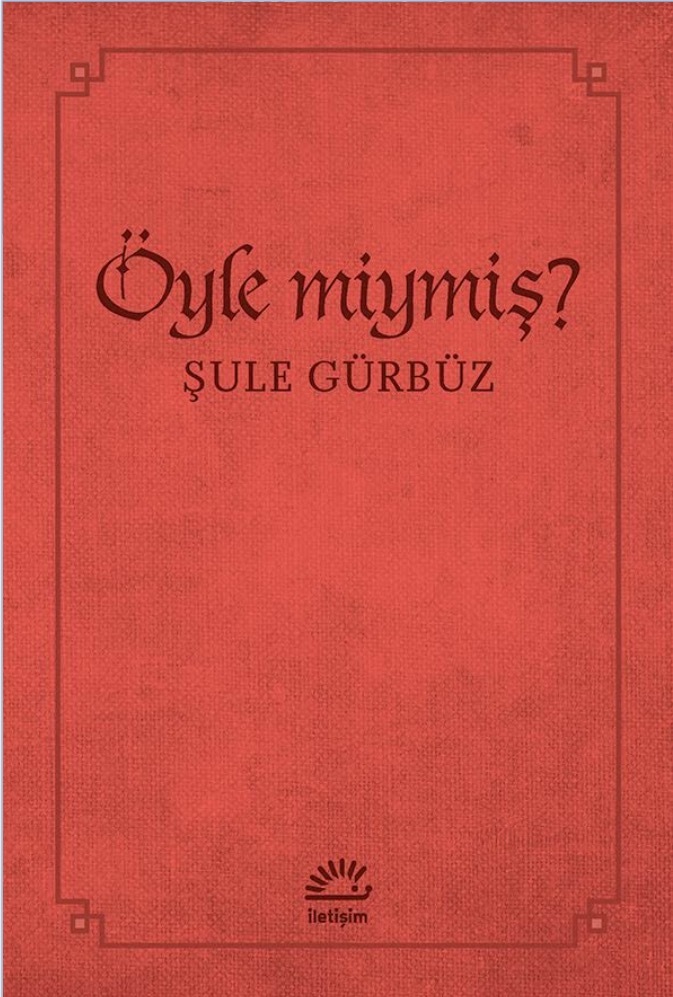
Öyle miymiş?
Şule Gürbüz
Şule Gürbüz’ün Zaman ve Anlam Arasındaki Yankısı Bir kitabı roman yapan nedir? Belirli bir olay örgüsü, gelişen karakterler, diyaloglar mı? Şule Gürbüz’ün “Öyle miymiş?” adlı
İncelemeyi Oku