




The Question of Distortion: Meaning or Interpretation? When it comes to understanding the Quran, the interpretations that translators silently embed within the text pose a serious danger. Verse 13 of Surah Al-Isra is a striking example of this. The original verse reads: "We have fastened every man's bird to his neck, and on the Day of Resurrection We shall bring forth a book which he will find spread open. 'Read your book; your own self suffices you this day as a reckoner against you.'" (Al-Isra 13–14) In certain translations and commentaries, this verse has been rendered as something like: "We have made everyone's fate contingent upon their own striving." Yet this is not translation — it is ideological intervention. The word tā'ir in the verse means "bird," and the bird is tied to the neck; wherever the person goes, the bird is there, the record is in pursuit. On the Day of Judgment that person's book will be brought forth, and their own self will hold them to account. There is no mechanism of "earning" based on human will here; everything has been written in advance, the ink has dried, and what the pen wrote has been completed. Similarly, the verb yashā'u, which recurs throughout the Quran, carries a clear grammatical meaning. Derived from the root letters shin-ya-hamza, this verb in the third-person singular masculine present tense means "He wills," and the subject of the verb, depending on context, refers to God. Translating it as "whoever deserves" or "whoever wills (it for themselves)" is to import a meaning from outside the text. In Surah Al-Qasas 56, this is absolutely clear: "Indeed, you do not guide whom you love, but God guides whom He wills." Even the Prophet Muhammad could not guide those he loved to the right path. That the one who wills is God is beyond dispute — grammatically, semantically, and theologically. The Testimony of Physics: The Absence of an Absolute "Now" Modern physics' understanding of time stands in sharp contradiction to our intuitive, everyday experience. Einstein's special theory of relativity fundamentally demolished Newton's picture of absolute and universal time. Simultaneity is relative; an event that appears to occur at the same moment for two observers may appear to occur at different moments for two other observers moving at different velocities. There is no universal, objective "now." According to the block universe interpretation, past, present, and future are not ontologically distinct from one another; time is a dimension like space, and all events exist with equal reality within this four-dimensional structure. The "flow of time," under this interpretation, is not an objective reality but a subjective illusion. Within this framework, a critical question arises: if physics allows no absolute "now," where does the "now" experienced by consciousness come from? The answer comes from neuroscience: consciousness does not directly represent physical time — it reconstructs it. The experience of time is not a reflection of an ontological reality, but a cognitive production. The Quranic counterpart of this distinction is profoundly meaningful. In Surah Al-Hadid 22, it is stated: "No calamity befalls on the earth or in yourselves but it is inscribed in the Book of Decrees before We bring it into existence." The concept of the Lawh al-Mahfuz (the Preserved Tablet) carries an epistemological parallel with the block universe interpretation: past, present, and future exist simultaneously within God's knowledge. In Surah Al-Hajj 47, it is declared: "A day in the sight of your Lord is like a thousand years of your reckoning." Time is the mode of experience belonging to created beings; it is not an ontological necessity for the divine essence. From Libet to the Quran: The Illusion of Will In 1980, neuroscientist Benjamin Libet conducted experiments that turned the debate on free will upside down. The findings can be summarized as follows: the EEG activity in the motor cortex known as the "readiness potential" begins 350 to 500 milliseconds before subjects report their conscious sense of "deciding," while the physical movement occurs approximately 200 milliseconds after this conscious intention. In other words, the brain has already set itself in motion long before the person says "I have now decided to move." The conclusion is striking: the feeling of "deciding" is not the cause of the action, but a retrospective explanation the brain appends to that action. Consciousness does not produce a decision; it labels an already-produced action as "I did it." This finding is in deep harmony with several Quranic verses. In Surah Al-A'raf 188: "Say: I hold not for myself any harm or benefit except what God wills." And in Surah Al-Insan 30: "But you cannot will unless God wills. Surely God is All-Knowing, All-Wise." Even the Prophet Muhammad could not choose. The real agent of the experience of "willing" is God; consciousness merely labels the action God created with "I wanted it." Surah Al-Anfal 17 expresses this most powerfully: "It was not you who slew them, but God slew them. And you threw not when you threw, but God threw." The believer shoots the arrow, the enemy falls, and consciousness says "I killed." Yet the true agent is God. The feeling of will is nothing more than the temporal tag that consciousness attaches to the action God has created. The Brain Does Not Record Reality; It Narrativizes It The Libet experiments are not limited to motor actions. All perceptual processes involve similar delays. Visual stimuli travel from the retina to the visual cortex in 150–300 milliseconds; comparable delays apply to auditory and tactile stimuli. Consciousness is not real-time; it is a delayed system that labels the past as "now." In the flash-lag effect experiment, when a flashing light is presented simultaneously with a moving ball, observers report that the light lags behind the ball — even though physically the two are at the same location. The brain predicts the future position of the moving object and presents this prediction to the perceiver as "now." "Now" is not a representation of the physical instant, but of the brain's prediction. In the color phi phenomenon, two differently colored dots flash in sequence; the observer perceives a motion and color transition between them that does not actually exist. The brain takes two separate events and inserts a transitional narrative between them. In the cutaneous rabbit illusion, when the wrist is tapped twice and the elbow once, the observer feels the taps progressing evenly along the arm — even though the physical stimuli are at different locations. All of these phenomena point to a single conclusion: the brain does not record what happens — it narrativizes what happens. In Surah Fussilat 21, it is mentioned that the skin will be made to speak on the Day of Judgment, and it is stated: "God has made us speak." The person being spoken about experiences it as though they themselves are speaking; yet the one who creates the speech is God. Consciousness is appending a retrospective "I did it" narrative to the action God has created. The Deceptive Width of "Now" William James' concept of the specious present reveals that the subjective "now" is not a point but an interval of approximately 2–3 seconds. Its neural correlate is theta waves; oscillating at 4–8 Hz, these waves construct that 2–3-second window through the integration of several cycles. This is most clearly seen in musical experience. When a melody is heard, each note physically sounds and ends in a single moment; yet the melody is experienced as "now" even after the notes have ended. When you hear the last note, the first notes still feel like part of the present. "Now," then, is an extended temporal window that contains traces of the past and predictions of the future — not a fixed instant. The verse in Surah Al-Hajj 47 crowns this distinction on the theological plane: there is no past-future division in God's knowledge. The human "now," by contrast, is the product of a limited and delayed temporal window. The time of the servant and the time of the Creator are incomparable. Memory: The Continuous Rewriting of the Past According to the conventional understanding, memories are stored like fixed recordings. Modern neuroscience has shown this to be untrue. Every act of remembering rewrites the memory — a process called reconsolidation. When a memory is reactivated, it becomes labile (susceptible to change); the current context, mood, and expectations are incorporated into the memory, which is then reconsolidated. Elizabeth Loftus' research has documented this in striking fashion: information added to memory afterward becomes indistinguishable from genuine memories; temporal sequences can be reversed; causal links that never existed can be inserted. The phenomenon known as "false memories" demonstrates just how constructive a structure memory has. The significance of this finding in the context of fate is substantial. If even the past is being continuously rewritten, how reliable is the memory of "I chose"? The memory of a choice, just like the feeling of choice, is itself part of fate. Theodicy: Injustice or Ontological Reality? The sharpest objection raised against the belief in fate typically takes this form: "If I have no power of choice, why am I held responsible?" This objection accepts the illusion "I am consciously choosing right now" as though it were an ontological reality. Yet as has been demonstrated, this feeling is the brain's retrospective explanation. In Surah Yunus 99: "Had your Lord willed, all those on earth would have believed." God has willed that some should not believe. This is not arbitrary cruelty but the co-manifestation of the divine names of majesty (jalāl) and beauty (jamāl). Al-Rahmān (the All-Merciful) is understood only in the presence of punishment; Al-'Afuww (the Pardoner) manifests only in the presence of the sinner; Al-'Adl (the Just) is perceived only in contrast with injustice. The manifestation of the names requires opposites. In Surah Al-A'raf 179: "Certainly We have created for Hell many jinn and humans; they have hearts with which they do not understand, eyes with which they do not see, and ears with which they do not hear." And in Al-A'raf 198: "You see them looking at you, yet they do not see." And in Surah Al-Anbiya 100: "There they will groan, and they will not hear." Read carefully, these verses say: beings without consciousness neither see nor hear in this world, and will neither see nor hear in the hereafter. Consciousness is required to feel pain. God does not punish them with suffering, because no inner world capable of registering punishment exists. There is groaning, but they do not hear. Al-Qasas 68 and the Illusion of Partial Will (Juz'ī Irāda) Classical Islamic theology (kalām) has attempted to reconcile God's universal will with the human being's partial will (juz'ī irāda). This effort is understandable, since a foundation of will is sought as the basis of responsibility. However, Surah Al-Qasas 68 shakes this equation to its roots: "And your Lord creates what He wills and chooses. The choice is not theirs." If partial will were truly real in a meaningful sense, there would be a domain outside God's control — which would amount to a denial of universal will. This is precisely what neuroscience demonstrates as well: consciousness is not the cause of the action but its explanation. The servant experiences the created action as "I did it"; the very feeling of willing is itself fate. Tawakkul: The Psychology of Transcending the Illusion Those without belief in fate imagine they carry the full weight of life themselves; anxiety over sustenance, fear of death, dread of loss, and the constant struggle for control are the inevitable products of this illusion. When chronic, these lead to stress, depression, and anxiety. The one who has faith in fate knows that every event is God's creation. In Surah At-Tawbah 51: "Say: Nothing will befall us except what God has decreed for us." Yet tawakkul (reliance on God) is not passivity; it is acting while knowing that the one who creates the action is God. Holding on to the means is part of fate; knowing that the result comes from God is tawakkul. The attitude of the believer can be described as follows: instead of "I choose" — "God creates"; instead of "I succeeded" — "God granted it"; instead of "it happened to me" — "God ordained it." This is not merely a semantic shift but a recognition of ontological reality. The brain already labels the past as "now"; the one who believes in fate consciously makes this labeling correspond to reality. Time, Consciousness, and God's Absolute Will Physics says there is no absolute "now." Neuroscience shows that consciousness produces not the action but the label attached to the action. Research on memory reveals that even the memory of the past is continuously rewritten. All of these findings indirectly support the ontological reality of fate. The Quran expressed this long before, and directly: the bird is tied to the neck; the pen has written, the ink has dried. The agent of yashā'u is not the servant — it is God. The choice does not belong to humanity. Consciousness is nothing more than a spectator who experiences the stage God has created as "mine." "We have made everyone's fate contingent upon their own striving" — no such verse exists. This is an ideologically motivated interpretation injected into the text from the outside — a distortion. The real verse says: the bird is at your neck, the book has been written, the Day of Reckoning will come. And on that day, the one who holds you to account will be none other than your own self.

KİTAP İZLERİ
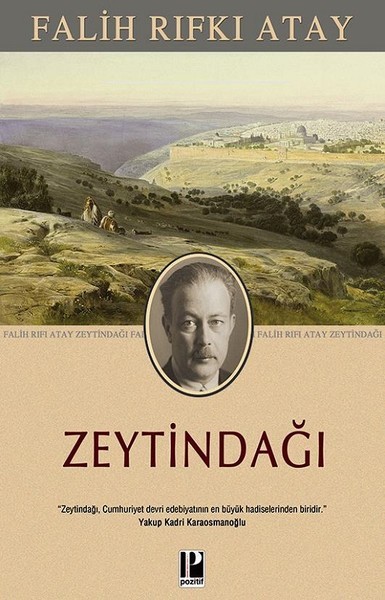
ZEYTİNDAĞI
Falih Rıfkı Atay
Bir İmparatorluğun Veda Mektubu: Falih Rıfkı Atay'dan Zeytindağı Her milletin tarihinde, hatırlamaktan kaçındığı, üzerine bir sessizlik perdesi çekmeyi yeğlediği dönemler vardır. Bizim için Osmanlı İmparatorluğu'nun
İncelemeyi Oku